In August 2025, the U.S. administration raised the import duty on Indian goods by an additional 25%, taking the total tariff burden to a staggering 50%—one of the highest among its global trading partners. Clouded by strategic friction over India’s Russian oil purchases, this tariff escalation has sent reverberations across India’s export markets, raising pressing concerns about competitiveness, GDP growth, and trade realignment.
The Tariff Shock: Scope and Immediate Impact
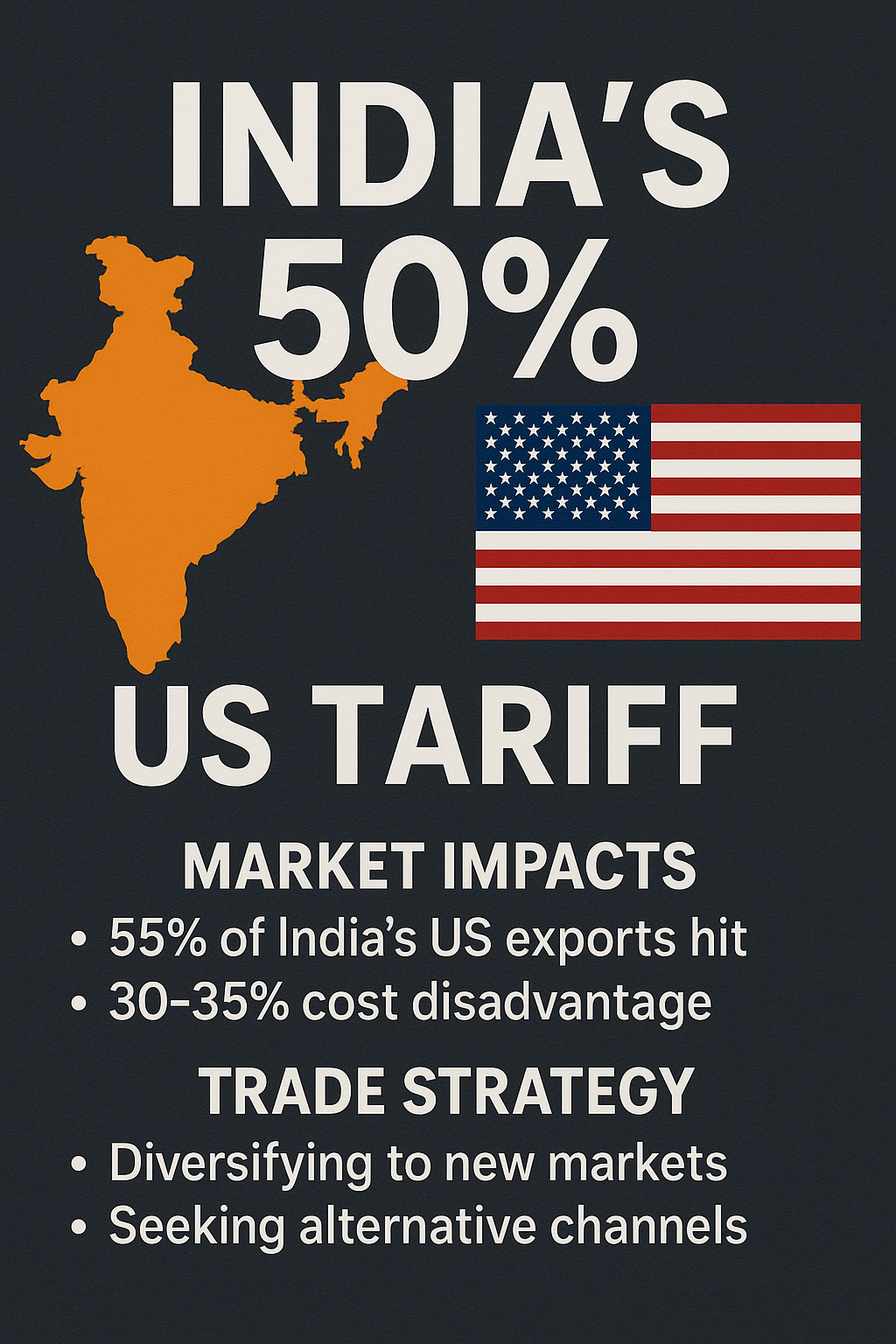
- The Federation of Indian Export Organisations (FIEO) described the 50% tariff as a harsh blow, warning that approximately 55% of India’s shipments to the U.S.—especially textiles, marine products, leather, and gems—would be severely impacted. This tariff surge places Indian exporters at a 30–35% cost disadvantage compared to those from competitor nations
- Sectors like textiles and apparel have already seen manufacturers in Tiruppur, Noida, and Surat halt production, unable to price goods competitively amid sharp margin pressure
- The gem & jewellery industry, too, is scrambling—exploring manufacturing bases in Dubai and Mexico as channels to bypass the punitive duties
Economic Ripple Effects & Forecasts
- Leading rating agencies like Moody’s estimate this tariff could shave 0.3 percentage points off India’s GDP growth in FY2025–26. Still, robust domestic demand and a vibrant services sector may offer partial buffering
- Estimates from Bloomberg suggest a long-term drag of up to 1 percentage point on potential GDP growth, jeopardizing India’s manufacturing ambitions and the “Make in India” initiative
- The broader picture painted by the Financial Times highlights threats to manufacturing, geopolitical realignment, and increased reliance on alternate markets like China and Russia
tariff-induced margin pressures
Export Strategy: Mitigation and Market Diversification
- Indian business leaders are prioritizing market diversification, particularly in textiles, gems, jewellery, and seafood, to offset lost U.S. demand
- Domestic banks are stepping up with trade finance, offering temporary interest rate relief, flexible repayment terms, and working capital lines to help exporters manage cash-flow impacts and shipment delays
- The government, meanwhile, considers credit guarantees and policy support to stabilize export-led sectors
Trading Terminology & Market Dynamics
- Tariff escalation: The doubling to a 50% duty is a stark escalation that redefines cost structures for exporters.
- Competitive disadvantage: Indian exporters now face a significant margin squeeze, undermining market entry and retention.
- Diversification strategy: With U.S. demand contracting, firms must broaden their trade portfolio, seeking alternative buyers across regions like the Middle East, Africa, and ASEAN.
- Working capital stress: Higher costs and order cancellations are squeezing liquidity, highlighting the importance of export financing solutions.
- GDP drag: Repeated forecasts flag trade policy as a key determinant of macroeconomic momentum.
For India, the 50% U.S. tariff marks a critical inflection point in trade policy. Addressing the macroeconomic implications will require a coordinated response—balancing strategic resilience with immediate export support. While tariff-induced margin pressures and inventory backlogs are immediate challenges, the path forward lies in recalibrated trade routes, financial safeguarding for exporters, and diplomatic outreach. In the longer run, India’s ability to stand its ground could reshape its trading alliances—reinforcing economic sovereignty, even as it rebuilds access to global markets.