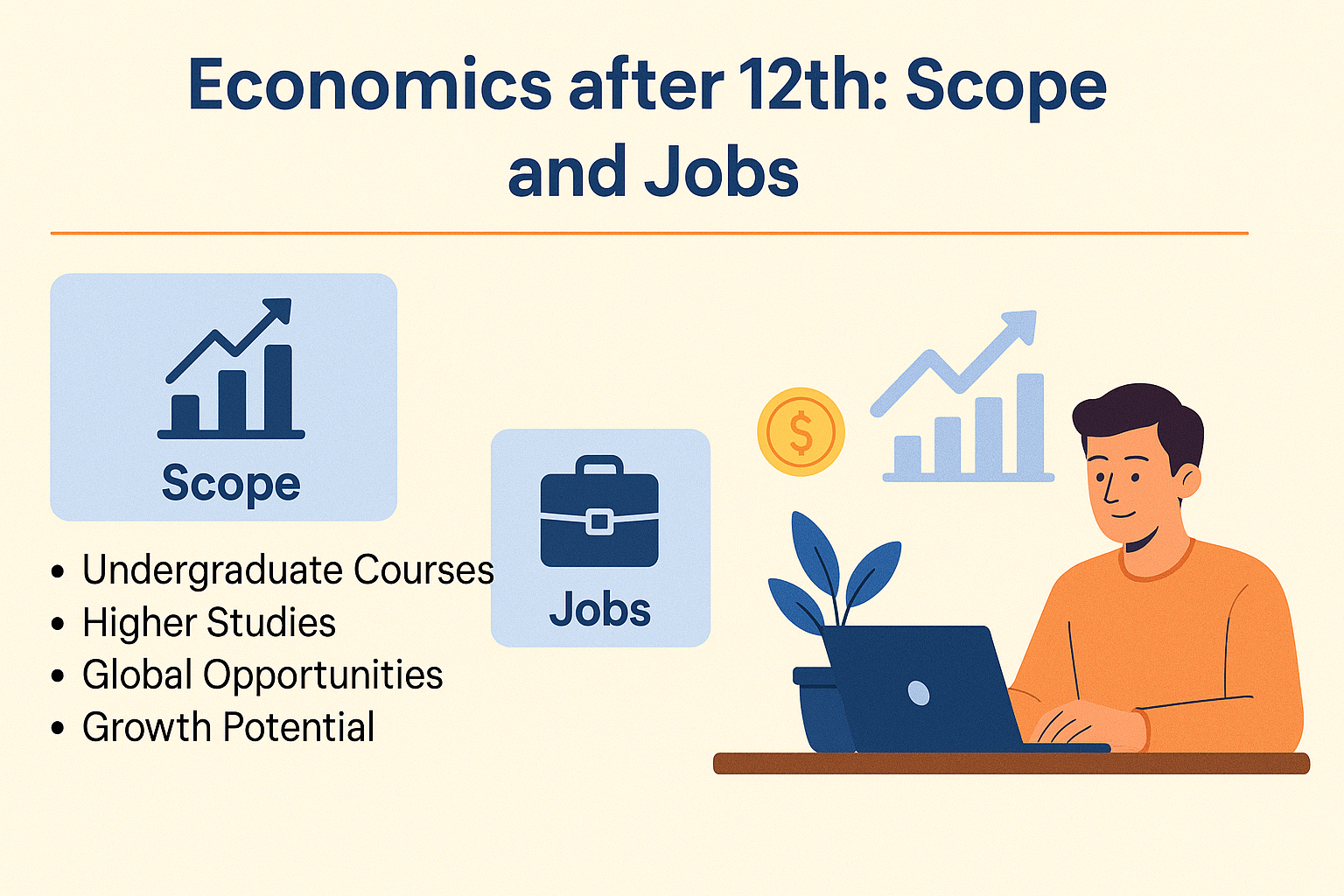
Economics is one of the most promising subjects you can pursue after 12th. With a unique blend of analytical thinking, mathematics, data interpretation, and understanding of human behavior, economics opens the door to a wide range of career opportunities in both the public and private sectors.
In this blog post, we’ll explore the scope of economics after 12th, the best courses you can pursue, career options, salary expectations, and growth opportunities.
📘 What is Economics?
Economics is the study of how individuals, businesses, governments, and nations make choices on allocating resources to satisfy their needs. It covers two main branches:
-
-
Microeconomics—focuses on individual and business-level decisions.
-
Macroeconomics—deals with economy-wide phenomena like inflation, unemployment, and national income.
-
🎓 Courses to Pursue After 12th Economics
If you studied economics in Class 12, here are some top undergraduate courses you can pursue:
1. B.A. in Economics
-
Duration: 3 years
-
Focus: Theory of economics, economic policy, public finance, Indian economy, statistics.
-
Eligibility: 10+2 from any stream (preferably with economics/maths)
2. B.Sc. in Economics
-
Duration: 3 years
-
Focus: More mathematical and statistical than B.A. Economics.
-
Eligibility: 10+2 with Mathematics
3. B.Com. with Economics
-
Duration: 3 years
-
Focus: Commerce subjects with a focus on economic principles.
-
Good for students looking to enter finance, banking, or CA.
4. BBA in Economics or Business Economics
-
Duration: 3 years
-
Focus: Combines business management with economic theory.
-
Suitable for students aiming for managerial roles.
5. Integrated M.A. or M.Sc. in Economics (5-year course)
-
Institutions like IIT Madras offer such courses.
-
Ideal if you’re targeting research or a Ph.D. in economics.
Economics is not just about money; it’s about decision-making, policy.
📈 Scope of Economics in India
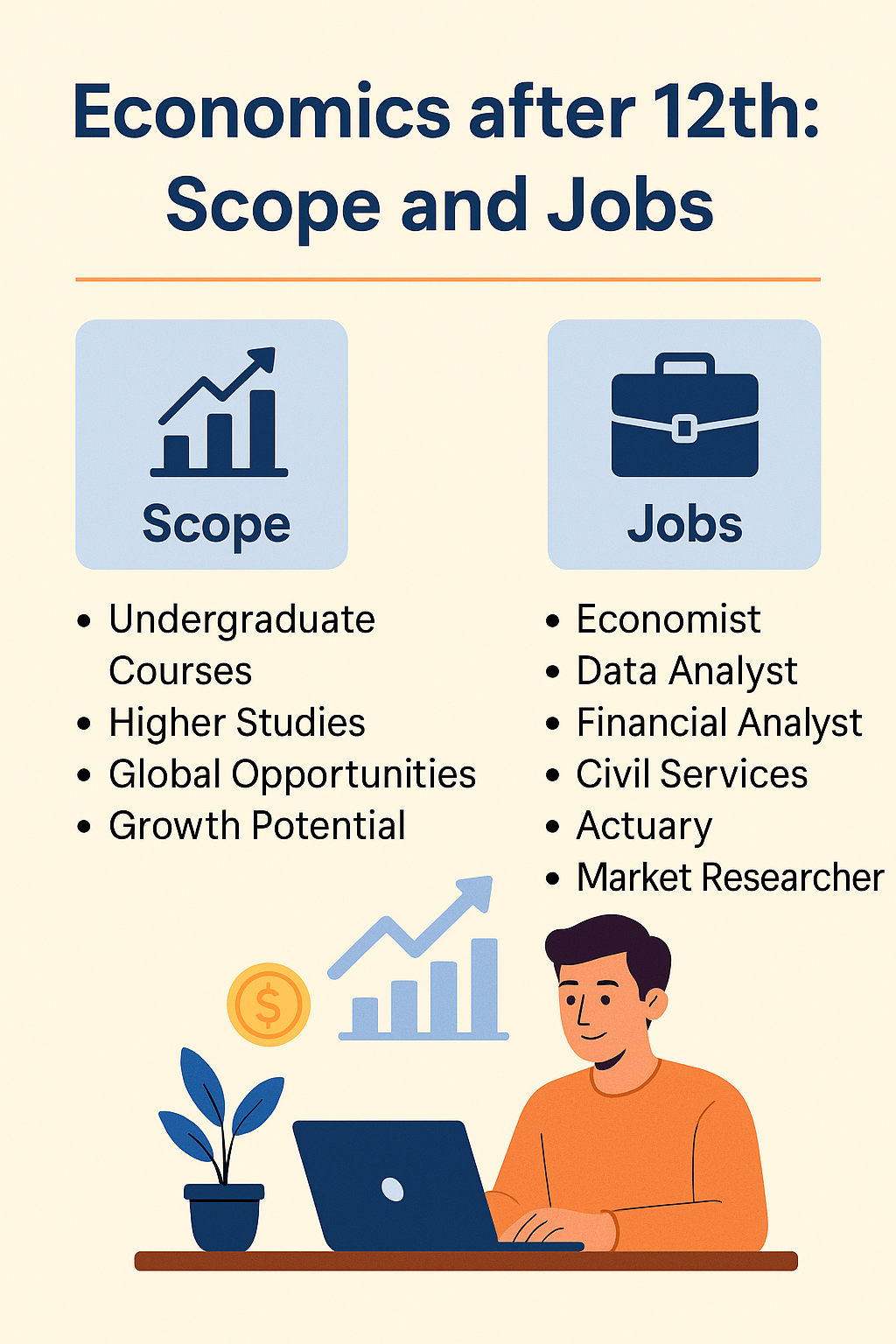
The importance of economics has grown significantly with globalization, digital finance, e-commerce, and policy reforms. Here’s how the scope is increasing:
-
Policy-making roles in government bodies like NITI Aayog.
-
The banking and finance sector demands economists for risk analysis and financial forecasting.
-
Data analytics & big data increasingly require economic insight.
-
Startups and businesses look for economists to understand markets, pricing, and consumer behavior.
💼 Job Opportunities After Studying Economics
Here are some top career options available after completing your graduation in economics:
1. Economist
-
Work with government, think tanks, and international organizations (UN, IMF, World Bank).
-
Role: Analyze economic trends, create reports, and advise on policy.
2. Data Analyst / Research Analyst
-
Industry demand is rising in finance, healthcare, and e-commerce.
-
Skills required: Excel, SQL, R, Python, SPSS.
3. Financial Analyst
-
Works in investment banking, mutual funds, and private equity firms.
-
Analyze company performance, stock trends, and market risk.
4. Civil Services (IAS/IES)
-
Economics graduates are eligible for UPSC Civil Services and Indian Economic Services.
-
IES is exclusively for postgraduates in economics.
5. Banking Jobs
-
Positions: Probationary Officer (PO), Economist, Credit Analyst
-
Employers: RBI, SBI, NABARD, ICICI, HDFC, etc.
6. Actuary
-
Combine economics with statistics and finance.
-
High-paying job in insurance and pension fund sectors.
7. Market Researcher
-
Helps companies understand consumer behavior and product demand.
-
Suitable for marketing and business development fields.
8. Statistician
-
Reputed jobs in CSO (Central Statistics Office), NSSO (National Sample Survey Office), and private research firms.
9. Teaching / Academia
-
After post-graduation or a Ph.D., you can become a professor or researcher.
-
Growing demand in government universities and foreign institutions.
10. Corporate Jobs
-
Roles in business strategy, operations, and policy advisory.
-
Companies like Deloitte, McKinsey, Amazon, and PwC hire economics graduates.
🌍 International Opportunities
A degree in economics is highly valued across the world. You can pursue:
-
Higher studies like M.A./M.Sc. in Economics from top universities (LSE, Oxford, Harvard)
-
Global jobs in NGOs, economic advisory bodies, and the United Nations.
💸 Salary Expectations
Salary varies based on your skill, role, and experience:
| Job Role | Average Salary (₹/annum) |
|---|---|
| Economist | ₹6 – ₹12 LPA |
| Data Analyst | ₹4 – ₹8 LPA |
| Financial Analyst | ₹5 – ₹10 LPA |
| Actuary | ₹8 – ₹20 LPA |
| Market Research Analyst | ₹3 – ₹6 LPA |
| Teaching (Assistant Prof) | ₹5 – ₹9 LPA |
Note: Salaries can be significantly higher with foreign degrees or experience.
🧠 Skills You Should Develop
To thrive as an economist or analyst, develop these skills:
-
Analytical & logical reasoning
-
Mathematics & statistics
-
Communication & writing
-
Data visualization (Excel, Tableau)
-
Coding basics (Python/R)
-
Current affairs & economic news reading
🏫 Top Colleges in India for Economics
-
Delhi University (SRCC, St. Stephen’s, Hindu)
-
Jawaharlal Nehru University (JNU)
-
Ashoka University
-
IIT Madras (Integrated Economics)
-
ISI Kolkata/Delhi
-
Presidency University, Kolkata
-
Mumbai University
✅ Final Words
Economics is not just about money; it’s about decision-making, policy, and understanding how the world works. It offers a diverse career path with excellent growth potential.
If you have a curious mind, love patterns, numbers, and people, and want to make a difference in society or business, economics is the right path for you after 12th.