
If you publish or share one global story this week for Google reach, make it this: AI climate impact is no longer just about data centers. A 2026 study in the Nature Portfolio journal npj Climate Action models how artificial intelligence acts as a productivity amplifier across energy systems — and finds that gains on the fossil side can raise net world CO₂ even when renewables also improve.
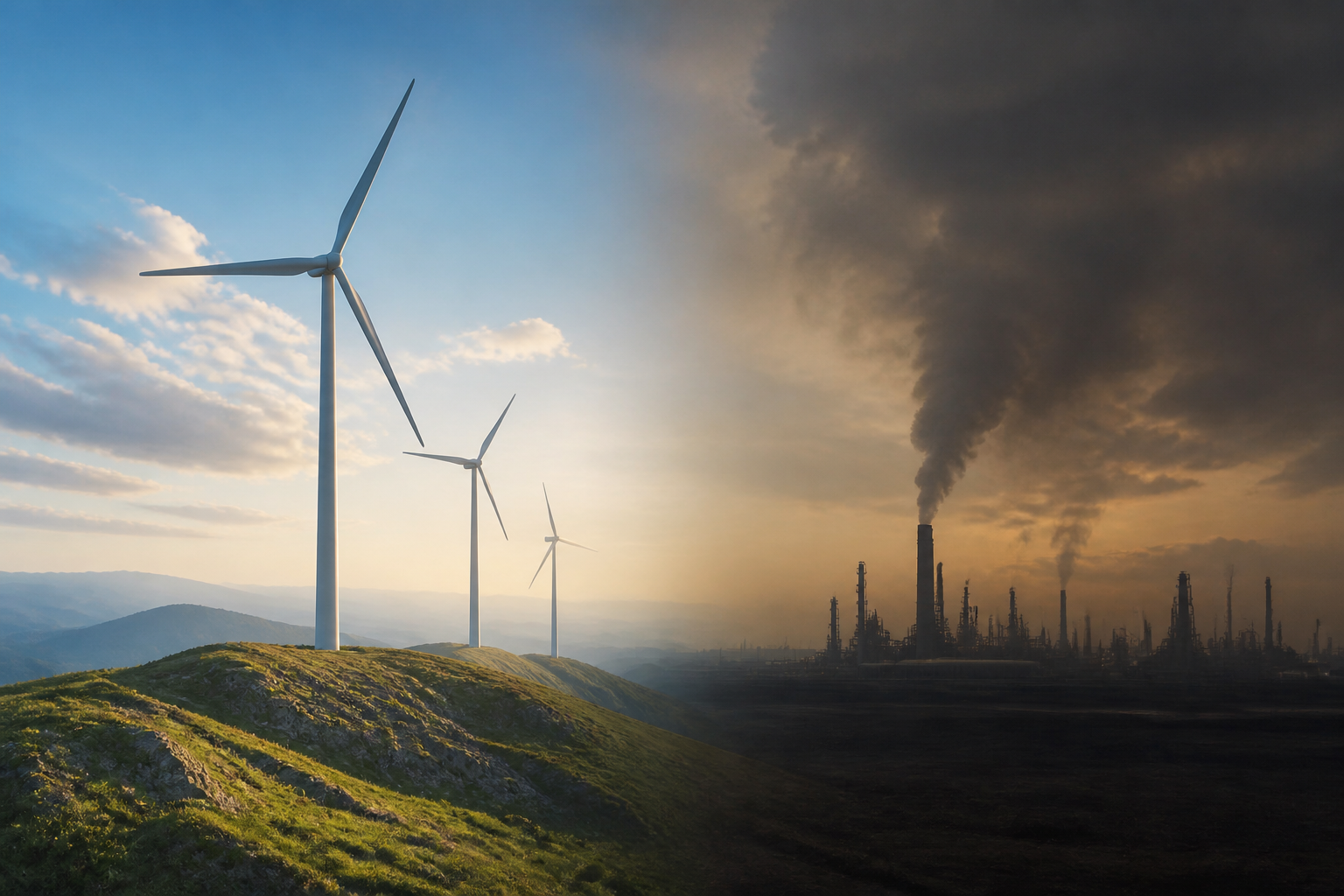
What “enabled emissions” means
Most public debate counts electricity used to train and run models. That matters — hyperscale campuses are driving new power demand, including private gas plants in some markets. But the study focuses on a second pathway: enabled emissions, created when oil and gas operators use AI to find, extract, refine, and sell fossil energy more efficiently.
In a global energy–economy model, those productivity gains increase fossil supply competitiveness. More fossil throughput means more combustion downstream — emissions “enabled” by AI tools, not only by server racks.
The headline numbers (global scale)
- Under parallel AI adoption across fossil and renewable pathways, modeled net annual CO₂ rises by about 0.47–1.8 gigatonnes
- That is roughly 1.2–4.8% of 2024 global energy-related CO₂
- Enabled fossil-side effects can dwarf today’s data-center footprint in some comparisons (coverage cites about 3–13×)
- Renewables productivity gains would need to outpace fossil gains by roughly 4–5× before the balance tips to net reductions
“Like any tool, AI can accelerate whatever it’s applied to… it has also been boosting the productivity of the fossil fuel industry for years, and our research shows that effect is asymmetric.” — Will Alpine, lead author (as quoted in coverage of the study)
Absent policy steering, AI’s modeled effects increase the carbon intensity of the global economy and reinforce fossil fuel incumbency — outcomes current governance often undercounts.
Why this is a perfect guest-blog topic for Google
International readers search phrases like “AI carbon footprint,” “AI climate impact 2026,” “are data centers bad for climate,” and “AI fossil fuels emissions.” A clear explainer with FAQ schema, shareable quotes, and two images earns:
- Evergreen traffic (climate + AI stay searchable all year)
- Backlink potential from tech, policy, and environment sites
- Internal links to related tech safety coverage on your site
Pair this global piece with our earlier OpenAI Astra cyber-capability pause to build topical authority across AI risk — not only chatbots.
What the world should do next
- Measure the full stack — data-center power and enabled fossil productivity
- Steer deployment — prioritise grid, storage, and renewables optimisation over fossil extraction AI
- Watch new gas for AI — off-grid plants can lock in decades of emissions
- Set policy guardrails — treat AI as a lever that amplifies whichever energy system it serves
AI is not automatically green. It is a multiplier — and multipliers cut both ways.
FAQ: AI climate impact (global)
Open answers for the searches people type worldwide.
What is AI climate impact beyond data centers?
Besides electricity for servers, AI can make fossil supply chains more productive, raising extraction and combustion — “enabled emissions” that a 2026 study finds can outweigh renewables-side savings.
How much could AI raise global CO₂?
Modeled parallel adoption increased net annual emissions by about 0.47–1.8 Gt CO₂ (roughly 1.2–4.8% of 2024 energy-related global CO₂).
Are enabled emissions bigger than data center emissions?
Coverage of the study says fossil-enabled effects can be several times larger — in some comparisons about 3 to 13 times — than current AI data-center emissions.
Can AI still help fight climate change?
Yes. AI can improve renewables, grids, and efficiency. Net cuts appear only when clean-side gains strongly outpace fossil gains, or when policy limits fossil AI amplification.
Why are companies building private gas plants for AI?
Data centers need fast, reliable power. In some markets, firms are adding behind-the-meter gas generation to bring capacity online quickly — raising separate climate and community concerns.
What should readers share from this guest post?
Share the core line: AI multiplies whatever energy system it serves — so climate strategy must govern use cases, not only count megawatts in the server hall.